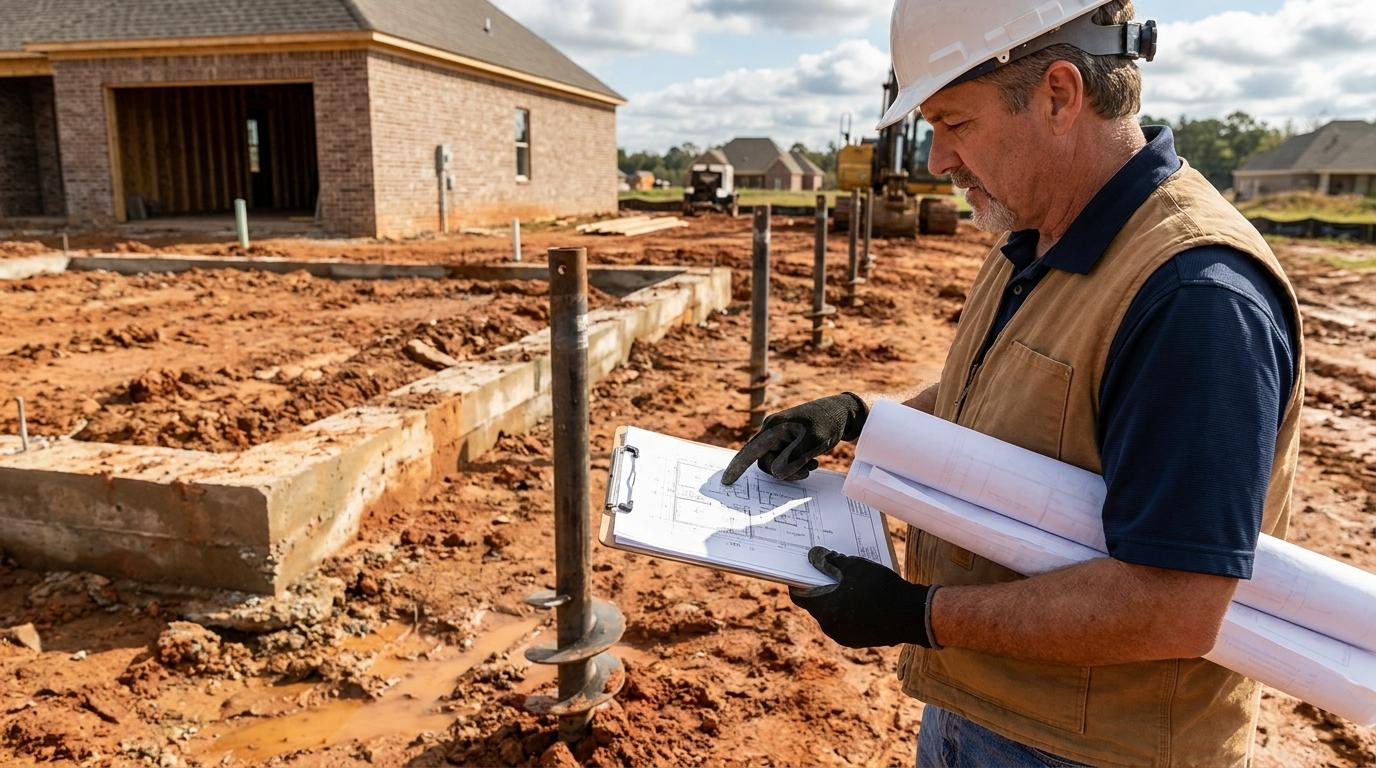
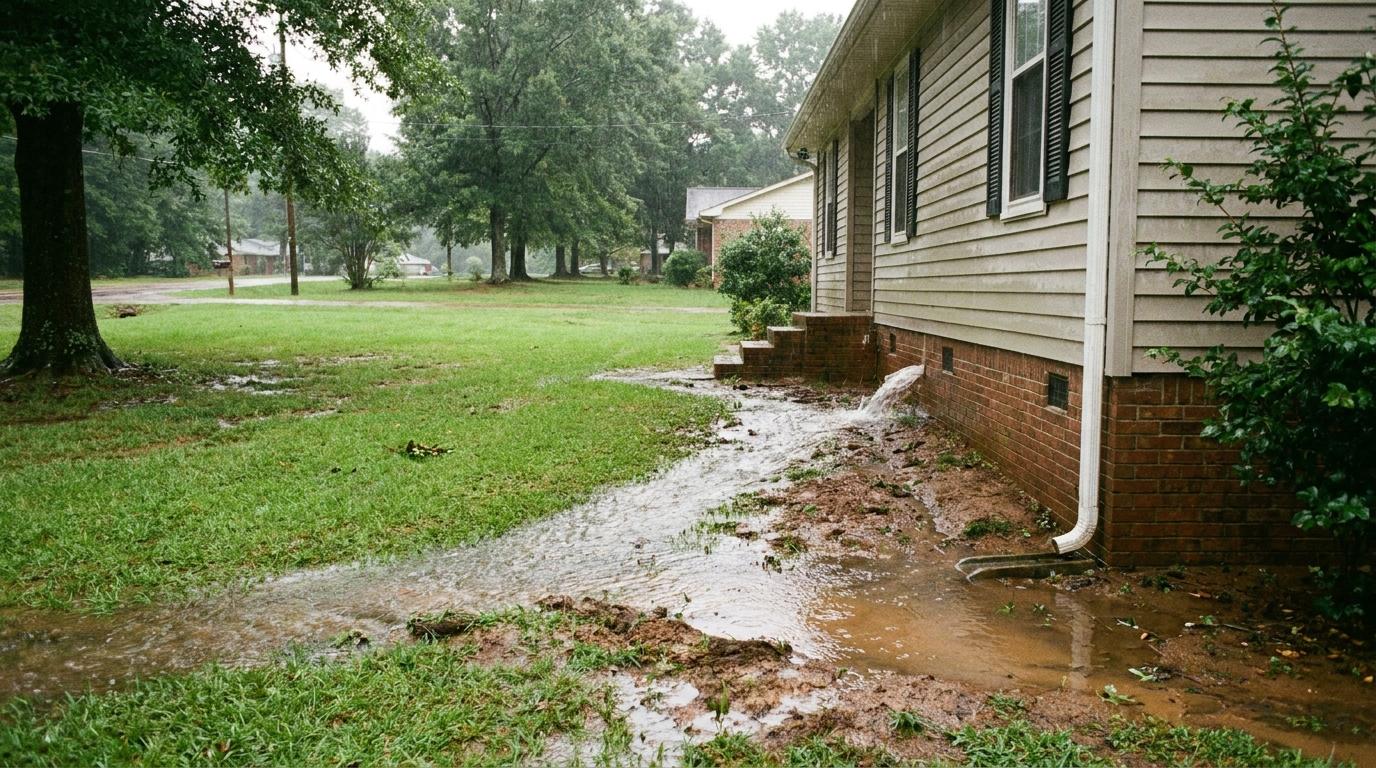
How French drains work is simple: a perforated pipe buried in a gravel-filled trench collects groundwater and redirects it away from your foundation. For Mississippi homeowners facing expansive clay soils and heavy seasonal rainfall, it’s one of the most effective ways to protect a home’s structural integrity. Superior Foundation Services installs French drains across Jackson, Ridgeland, and Central Mississippi.
Mississippi receives significantly more annual rainfall than the national average. When that rain hits Yazoo clay, it doesn’t move the way it would in sandier soil. It lingers, keeping the ground around your foundation saturated well after the storm ends. That’s when soil movement, moisture intrusion, and foundation stress quietly begin.
What a French Drain Is and How It Works
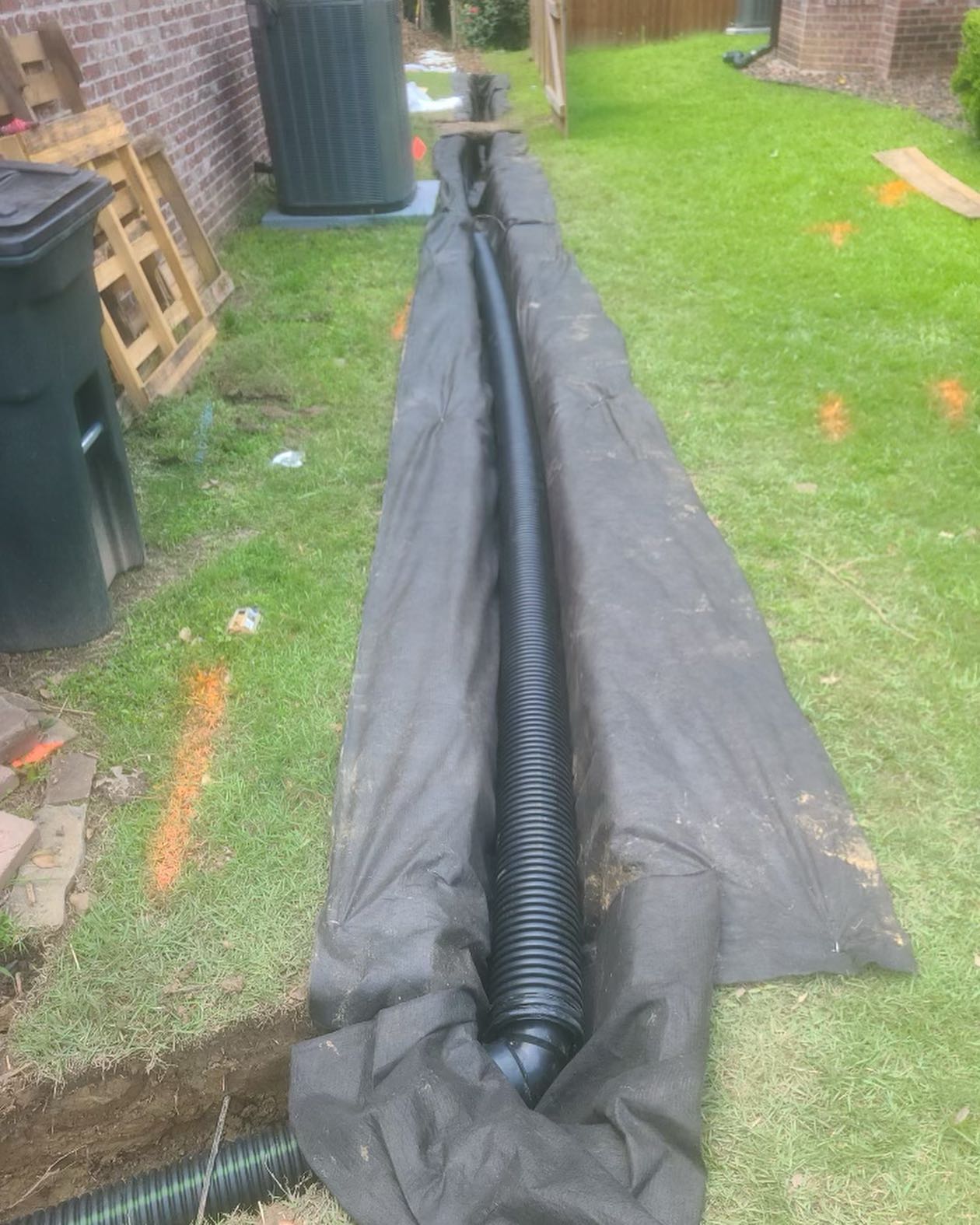
A French drain is a passive system: no pumps, no electricity, just gravity. A trench is dug on a slight slope, lined with landscape fabric, filled with washed gravel, and fitted with a perforated pipe at the bottom. Groundwater seeps into the gravel, enters the pipe, and flows to an outlet well away from the foundation.
The slope is critical. Contractors aim for at least 1 inch of drop per 8 feet of run. In the flat yards common around the Jackson metro area, that means digging deeper at the outlet end to achieve the proper grade. A drain with an insufficient slope backs up and fails.
The drainage solutions that hold up in Mississippi are built for high rainfall volume and slow-draining clay. Effective drainage in our area typically consists of a 4- to 6-inch PVC pipe, deeper trenches, and landscape fabric wrapped tightly around the gravel bed to keep clay particles from clogging the stone over time.
Signs Your Home Might Need a French Drain
Water problems don’t always announce themselves as a flooded yard. Mississippi homeowners in Madison County and Rankin County often encounter subtler signs first:
- Standing water that takes more than 24 hours to absorb after rain
- Efflorescence (white mineral deposits left by water migrating through concrete) along basement or crawl space walls
- Soil erosion near the foundation, or mulch washing away from beds alongside the house
- Foundation cracks that widen or reappear during wet seasons
When two or three of these occur together, the soil around your foundation is likely staying wet long enough to cause structural stress. Foundation drainage services in Jackson, MS include a free evaluation to identify whether poor drainage is contributing to any foundation movement.
What French Drain Installation Involves

Every French drain installation starts with locating the utility lines. In Mississippi, call 811 to have underground lines marked at no charge before digging.
Once the route is confirmed, contractors excavate to 18 to 24 inches, lay the perforated pipe, add gravel, fold the fabric, and backfill. Most residential jobs take one to two days. French drain installation involves trenching near the foundation and requires precise grading, so most homeowners hire a licensed contractor rather than attempting it as a DIY project. After installation, maintaining your French drain is minimal: clear the outlet annually and check exposed access points for sediment. A well-built system is designed to perform long-term with minimal intervention.
If drainage has already contributed to foundation movement, reach out to Superior Foundation Services for a combined assessment—drainage correction typically comes before structural repairs.
Frequently Asked Questions
Can a French drain be installed next to an existing foundation without damaging it?
Yes, French drains are regularly installed alongside existing foundations without causing structural disruption. Excavation depth and distance from the footing are carefully controlled. For homes where drainage has contributed to foundation movement, Superior Foundation Services recommends a combined evaluation, since addressing drainage before structural repairs produces more durable results.
How deep does a French drain need to be to protect a foundation?
French drains for foundation protection are typically installed at 18 to 24 inches deep in Mississippi. That positions the pipe below the worst surface saturation zone and allows adequate slope toward the outlet. Depth alone doesn’t determine performance. A drain that exits into standing water or a spot with no gravity path still fails at the job.
Is a French drain the same as a curtain drain?
A curtain drain is a type of French drain, but it serves a different purpose. A curtain drain runs across a slope to intercept groundwater moving downhill before it reaches a structure. A standard French drain runs along the foundation perimeter to collect water already in that zone. Same materials, different placement.
Protect Your Foundation Before the Next Storm Season
If the same low spots flood after every storm, or you’re seeing early moisture signs along your foundation walls, now is the right time to act. Mississippi’s spring storm season puts real pressure on homes with unmanaged drainage.
Superior Foundation Services has spent 15 years helping Mississippi homeowners protect their foundations from the ground up. Schedule your free inspection today.