Polyaspartic floor coating is rated for 20 to 25 years in Mississippi garages, compared to 15 to 20 years for polyurea and 5 to 10 years for standard epoxy. The difference comes down to UV stability, hot tire resistance, and how each material handles humidity during and after installation. Superior Foundation Services provides all three concrete coating options for homeowners across the Jackson metro area.
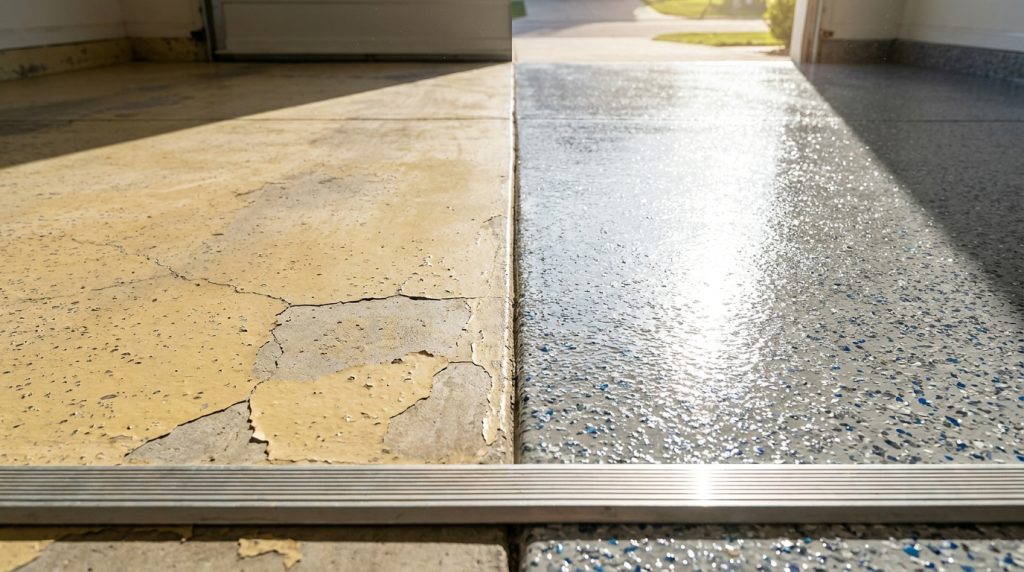
A homeowner in Madison had an epoxy garage floor installed three years ago. The coating near the garage door had turned yellow, and strips of epoxy were peeling wherever the truck parked overnight. The heat from highway-temperature tires was softening the coating and pulling it off the concrete. That failure pattern is common with standard epoxy in Mississippi’s climate, and it’s why the coating choice matters more here than in cooler, drier states.
How Each Coating Handles Mississippi’s Heat and Humidity
Mississippi garages regularly exceed 90 degrees from May through September, and summer humidity stays above 70%. Those conditions expose weaknesses in coating chemistry that don’t show up in cooler climates.
UV Stability
Epoxy uses aromatic chemistry that breaks down under ultraviolet light. The coating yellows, chalks, and becomes brittle near garage door openings. Polyaspartic and polyurea use aliphatic formulations that resist UV degradation and maintain their original color and gloss for the life of the coating.
Hot Tire Resistance
Tires reach 135 to 150 degrees after highway driving. Standard epoxy softens at those temperatures, and tire pressure presses the coating into tread patterns. When the tire cools and contracts, it pulls the epoxy off the concrete. Polyaspartic and polyurea resist hot tire pickup because their molecular bonds don’t soften at those temperatures. Standard epoxy still works in some garages (climate-controlled spaces, lower-grade vehicles, and short driveways), which is why some homeowners still choose it over the higher-end alternatives.
Cure Time and Downtime Compared
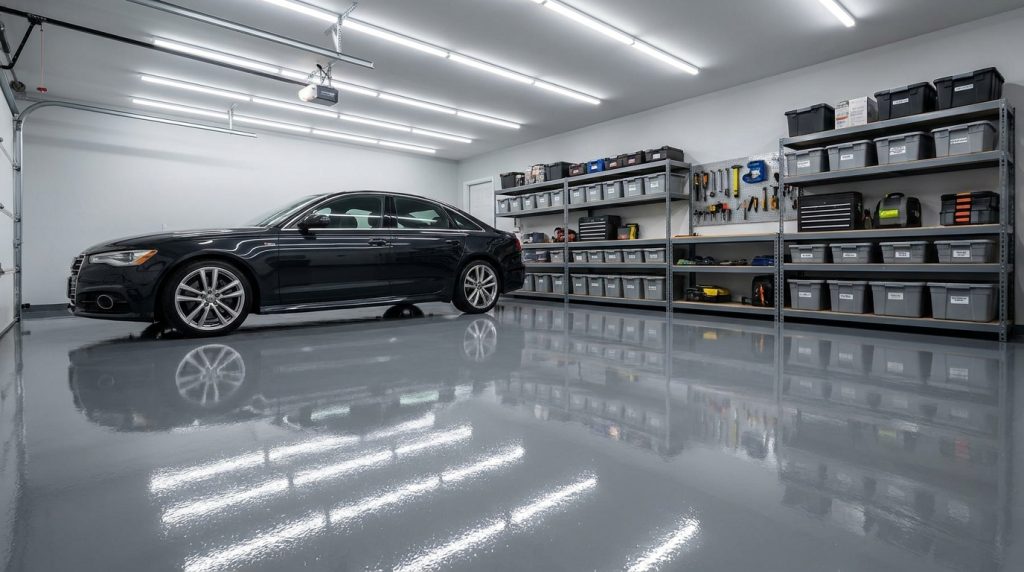
Polyaspartic and polyurea coatings are ready for foot traffic in two to four hours and vehicle traffic within 24 hours. A full garage floor coating installation using either system typically finishes in a single day.
Epoxy takes 24 to 48 hours before you can walk on it and three to four days before parking a vehicle. Full chemical cure extends to seven days or longer. In practical terms, an epoxy installation keeps your garage out of service for roughly a week. Epoxy’s narrow application window of 55 to 85 degrees also limits when it can be installed during Mississippi’s hottest months.
Long-Term Cost Per Year
Epoxy costs $3 to $7 per square foot installed. Polyurea runs $5 to $10. Polyaspartic costs $5 to $12. On a standard two-car garage, that puts epoxy at $1,500 to $3,500, polyurea at $2,000 to $5,000, and polyaspartic at $2,000 to $6,000.
When you divide cost by expected lifespan, the comparison shifts. A $3,000 polyaspartic system over 20 years costs $150 per year. A $1,500 epoxy system over seven years costs $214 per year, plus the labor and disruption of reapplication. For concrete coatings across garages, patios, and basements, the longer-lasting system typically delivers better value per year of service.
Frequently Asked Questions
Is polyaspartic worth the higher upfront cost?
For Mississippi homeowners, polyaspartic typically pays for itself through longer service life. A polyaspartic coating is rated for 20 to 25 years without reapplication, while epoxy commonly needs replacement in 5 to 10 years. The cost per year of protection is lower with polyaspartic even though the initial price is higher.
Can you apply polyaspartic over existing epoxy?
Yes, if the existing epoxy is properly prepared. The surface needs diamond grinding or mechanical abrasion to create a profile for the new coating to bond. Applying polyaspartic over failing, peeling, or moisture-compromised epoxy without proper prep leads to delamination of the new coating.
Which coating works best for a garage that gets direct sunlight?
Polyaspartic is the strongest choice for garages with sun exposure. Its aliphatic chemistry resists UV degradation, so it won’t yellow or chalk near the garage door opening. Superior Foundation Services recommends polyaspartic for south-facing and west-facing garages across the Jackson metro area.
Choose the Coating That Matches Your Garage
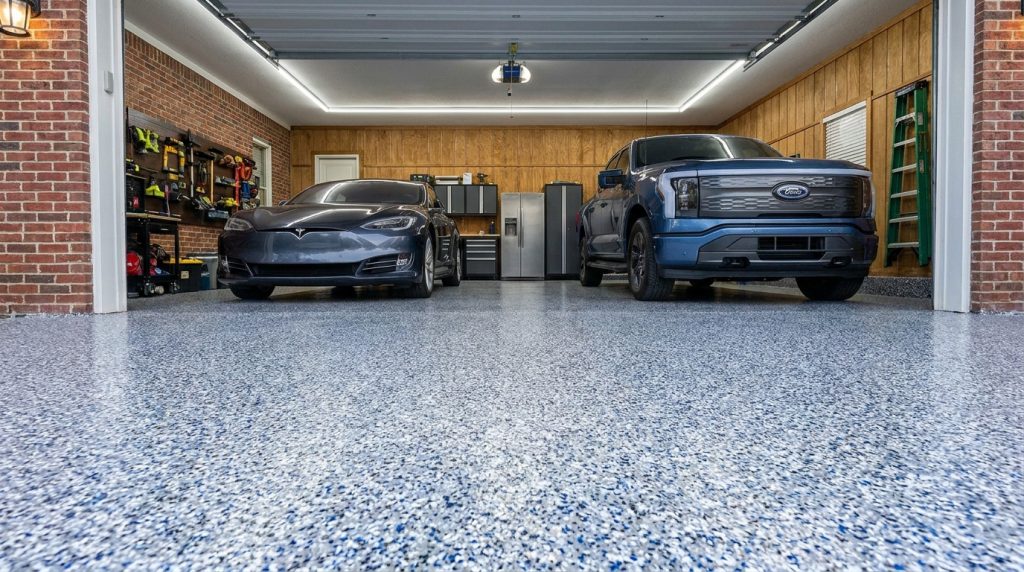
Epoxy works for covered, climate-controlled spaces where UV and extreme heat aren’t factors. Polyurea handles demanding conditions and cures fast. Polyaspartic delivers the longest lifespan, the widest application temperature range, and the best performance in Mississippi’s heat and humidity. The right concrete coating depends on your garage’s sun exposure, how you use the space, and how long you want the floor to last.
Superior Foundation Services provides free on-site assessments for garage floor coatings across the Jackson metro area. Call (601) 941-2125 or schedule your free estimate to compare options for your garage.